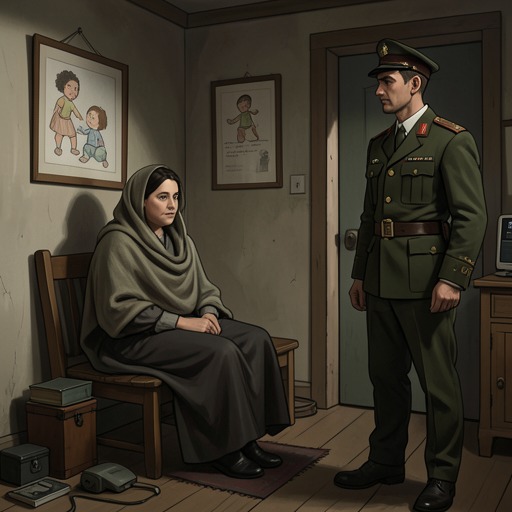
Arrest of Bekir Mustafayev
Grey BeesThe Arrest of Bekir Mustafayev is a further consequence of the uncertainty and coercion surrounding Akhtem Mustafayev’s disappearance. After Bekir is accused of stealing church candles that Sergeyich had actually brought to the family, Sergeyich goes to the police station in Bakhchysarai hoping to clear him. The apparent candle theft, however, is only one part of the authorities’ case: Bekir is also accused of driving his dead father’s car without official permission, and is presented with a choice between prison and military service.
Background: A family living with disappearance
When Sergeyich first visits Akhtem’s household, Aisylu tells him that Akhtem has been gone for twenty months. She says that Cossacks took him, along with two other people, after they had travelled together to the mosque in Bakhchysarai. Their car was found empty; a child had reportedly seen them being forced into a minibus. The family has received no reliable account of what happened to them.
The uncertainty acquires a grim official dimension when Sergeyich asks about the police investigation. At an office, Ivan Fyodorovich tells him that Aisylu should speak to the police and that the case might concern Crimean Self-Defence or the Cossacks. The phrase that arrests Sergeyich’s attention is the instruction to tell Akhtem’s widow. When he asks whether Aisylu is a widow, Ivan Fyodorovich retracts the word: the case is not closed, he says, and many similar cases remain with the police, beyond his office’s control. Later, a Tatar tells Sergeyich that Akhtem’s body has been found buried in the woods and that he was killed long ago. Aisylu subsequently thanks Sergeyich for going to Simferopol, saying that without his intervention Akhtem would not have been returned. The family’s grief therefore precedes Bekir’s arrest; it is not resolved by the recovery of Akhtem’s body.
The candle accusation
When Sergeyich returns to Aisylu’s house, the Berkut officers are gone from the street, but the household is facing a new crisis. Aisylu tells him that Bekir has been arrested. Police searched the house, and a detective accused Bekir of robbing a church and stealing candles. A candle burns in front of the draped mirror in the living room, making the accusation immediate and concrete rather than abstract.
Aisylu disputes the charge with specific circumstances: someone had left the candles at their door during a power outage, and Bekir was away in Qarasuvbazar that day. Sergeyich then acknowledges that the candles are his. He had taken them from a church in his home village after it was bombed and had brought them to Aisylu’s household. Once the candles’ origin is clear to him, he insists that Bekir did not steal them and agrees to tell the authorities. Aisylu directs him to the police station in Bakhchysarai, where Bekir has been taken; Aisha accompanies him and gives directions on the drive.
At the police station
Sergeyich expects his explanation to lead to Bekir’s release. He says that he came by car and can drive Bekir home, but the detective does not confirm that Bekir will be freed. Instead, he challenges Sergeyich for involving himself in other people’s affairs and says that the candles are not the only issue. Bekir, he claims, has been driving someone else’s car for two years without official permission and has spoken disrespectfully to the authorities.
Sergeyich objects that the car belonged to Bekir’s father, who has been killed. The detective accepts that the car is registered to the father, but says that the father never officially authorized his son to use it; under Russian law, he therefore treats Bekir’s driving as a continuing offense. Sergeyich points out the contradiction in demanding permission from a dead man. The exchange makes the legal problem plain: the father’s death does not end the authorities’ claim over the car, but leaves Bekir unable to produce the authorization they demand.
Threat and consequence
The detective tells Sergeyich that Bekir has two options: prison or the army. He presents military service as the preferable choice, saying it could teach Bekir to respect authority, or at least fear it. The threat shifts the encounter from a dispute over the candles to a broader exercise of power over a young man whose father has been killed and whose family has already endured an unresolved disappearance. The evidence does not establish which option Bekir ultimately faces or what happens to him after this conversation.
Sergeyich’s attempt to help exposes the limits of a simple defense. He can account for the candles and explain why Bekir had been using his father’s car, but the detective treats those explanations as insufficient to secure release. When Sergeyich asks what he should tell Bekir’s mother, he speaks more quietly and fearfully than before. The arrest thus extends the consequences of Akhtem’s death into Bekir’s present: the family’s loss is not merely a history to mourn, but a condition that leaves his son exposed to accusation and official pressure.